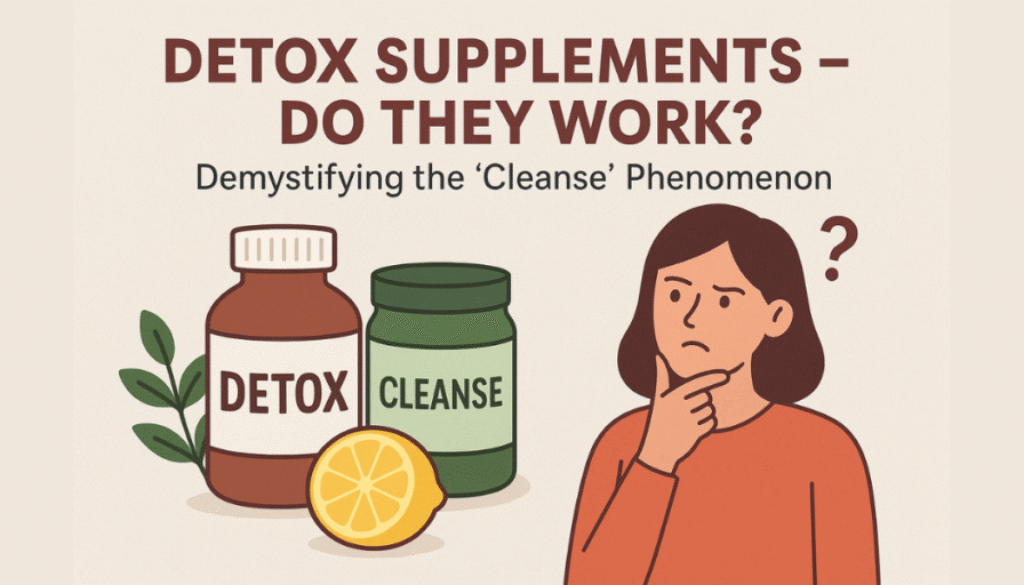
Detox Supplements – Do They Work? Demystifying the “Cleanse” Phenomenon
Walk through any health food store or scroll social media, and you’ll quickly encounter a flood of “detox” teas, powders, and pills claiming to flush toxins, boost energy, support liver health, and reset your system. These promises are powerful — and profitable — but they are also deeply misleading. As a pharmacist, I’ve watched the “cleanse” industry grow into a billion-dollar marketing machine built on a misunderstanding of how human physiology actually works.
The hard truth? Your body already has an extraordinary detoxification system. It operates continuously — 24 hours a day — without any need for special supplements, juices, or cleanses.
The Body’s Built-In Detox Systems
Your body doesn’t need an external “reset.” It is a self-regulating organism with an intricate, multi-organ system that processes and eliminates waste efficiently when properly supported by nutrition, hydration, and rest.
The liver is your body’s true detox powerhouse. It uses two major enzymatic phases to transform fat-soluble toxins into water-soluble forms that can be excreted through bile or urine. This process depends on a steady supply of nutrients — including B-vitamins, amino acids, and antioxidants — not on herbal blends promising a “total body cleanse.”
The kidneys filter your blood around the clock, excreting metabolic waste and maintaining electrolyte balance. Adequate hydration supports this process; expensive “kidney cleanse” supplements do not.
The lungs, skin, and gastrointestinal tract also contribute modestly to eliminating waste — through respiration, perspiration, and bowel movements. However, their roles are limited and already optimized by healthy habits like exercise, hydration, and fiber intake.
The Myth of “Toxin Buildup”
The concept of “toxins” used in marketing is intentionally vague. Detox products rarely identify what these “toxins” are, how they supposedly accumulate, or by what biochemical mechanism their product removes them. Yes, we are exposed to environmental pollutants and metabolic byproducts daily — but the body’s natural detoxification systems are remarkably efficient at handling these challenges. The notion that your system becomes “clogged” or “sluggish” without special intervention simply isn’t supported by science.
Breaking Down Common Detox Ingredients and Claims
Let’s look at what’s actually inside many popular “detox” supplements — and how their claims hold up under scientific scrutiny.
Laxatives like senna, cascara, or magnesium hydroxide are often the main active ingredients in “colon cleanses.”
- Marketing claim: “Eliminates accumulated waste and toxins.”
- Scientific reality: These agents induce bowel movements — nothing more. Overuse can cause dehydration, electrolyte imbalance, and dependence.
Diuretics such as dandelion or parsley appear in “water weight detox” formulas.
- Marketing claim: “Flushes toxins and reduces bloating.”
- Scientific reality: They increase urine output, which may reduce water weight but not toxins. The effect is temporary and largely cosmetic.
Antioxidants like vitamin C, vitamin E, or green tea extract are marketed to “cleanse at a cellular level.”
- Scientific reality: Antioxidants play legitimate roles in reducing oxidative stress, but isolated, high-dose supplements do not replicate the synergistic benefits of a balanced, plant-rich diet.
- Herbs such as milk thistle or burdock root are often advertised to “support liver function.”
- Scientific reality: While some herbs have mild hepatoprotective or diuretic properties, there is no credible evidence that they “regenerate” or “cleanse” the liver beyond what good nutrition already supports.
- Activated charcoal occasionally appears in detox products with claims that it “binds toxins.”
- Scientific reality: Charcoal can bind certain toxins in acute poisoning situations under medical supervision, but routine use can interfere with nutrient and medication absorption.
The Real Risks of Detox Supplements
Ironically, many detox products can do more harm than good. Laxative and diuretic misuse can cause dehydration and dangerous electrolyte shifts. Certain herbs may interact with prescription drugs, altering how they are absorbed or metabolized. And perhaps most concerning — the “detox” mindset can delay diagnosis of legitimate medical conditions by convincing people that fatigue, skin issues, or digestive symptoms are simply signs of “toxic buildup.”
Supporting the Body’s Natural Detoxification
If your goal is to support your body’s natural detox systems, skip the proprietary blends and focus on foundational physiology:
- Stay hydrated. Water facilitates kidney filtration and healthy digestion.
- Eat a fiber-rich diet. Fiber binds waste in the gut and supports a healthy microbiome.
- Choose nutrient-dense foods. B-vitamins, magnesium, antioxidants, and amino acids power detox enzyme systems.
- Include cruciferous vegetables. Broccoli, cauliflower, and kale promote healthy liver enzyme activity.
- Sleep and move regularly. Rest and circulation enhance natural cellular repair and waste removal.
- Reduce toxin exposure. Limit alcohol, processed foods, and unnecessary chemical exposures whenever possible.
The Bottom Line
The detox industry thrives on pseudoscience, fear, and the promise of quick fixes. But as a pharmacist, I can tell you this: the human body doesn’t need to be “reset” — it needs to be supported. True detoxification is not something you purchase; it’s something your body performs naturally when given proper nutrition, hydration, and rest.
Your body is already your most sophisticated detox system. Support it — don’t try to outsmart it with empty marketing claims.
Call to Action
For science-backed supplement insights and evidence-based wellness education, visit Evidence Education Wellness. Learn how to separate clinical truth from clever marketing — and make informed decisions that truly support your health.