Antioxidant Supplements – Miracle or Marketing?
Walk down any supplement aisle and you’ll be dazzled by promises of “powerful antioxidant protection,” “DNA defense,” and “free radical neutralization.” The language evokes an invisible war raging inside your cells—and these bottles, apparently, are your only defense. But beneath the bright labels and bold claims lies a story that’s less about biology and more about business.
Antioxidants—substances that counteract oxidative stress—are essential to life. Every breath you take produces reactive oxygen species (ROS), and your cells have evolved intricate systems (like glutathione, catalase, and superoxide dismutase) to keep those radicals in check. When balance falters, oxidative stress contributes to chronic disease, aging, and inflammation. So it’s easy to see why “antioxidant” has become a marketing buzzword synonymous with vitality and longevity.
The problem? Most antioxidant supplements don’t perform in the body the way they do in the lab.
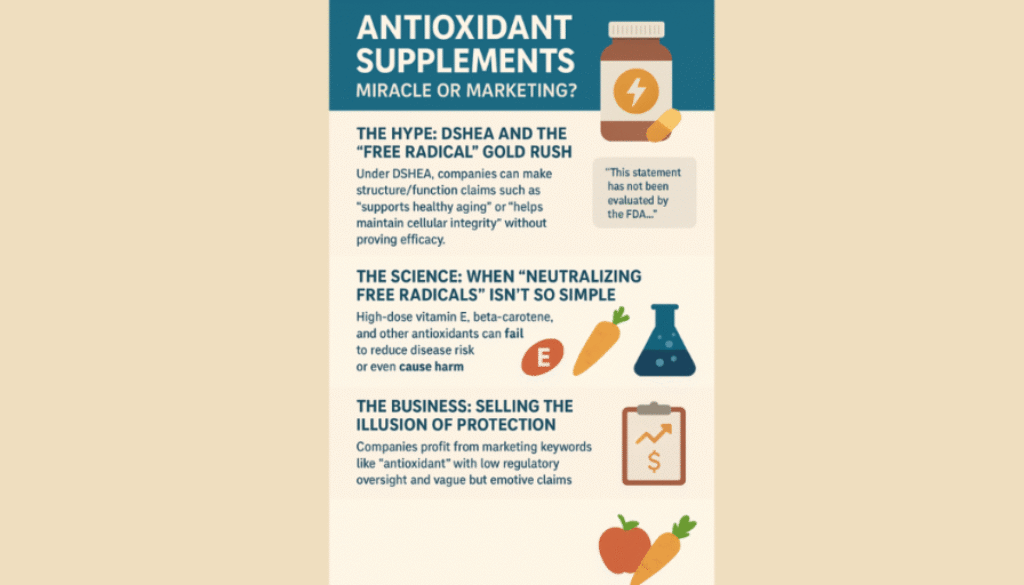
The Hype: DSHEA and the “Free Radical” Gold Rush
When the Dietary Supplement Health and Education Act (DSHEA) passed in 1994, it unleashed a tidal wave of creative marketing. Under DSHEA, companies could make structure/function claims such as “supports healthy aging” or “helps maintain cellular integrity” without proving efficacy—so long as they avoided direct disease claims and included the boilerplate disclaimer:
“This statement has not been evaluated by the Food and Drug Administration. This product is not intended to diagnose, treat, cure, or prevent any disease.”
That single sentence opened the door to decades of antioxidant hype. Suddenly, every vitamin C tablet, green tea capsule, berry powder and even a component of red wine (resveratrol) could position itself as a miracle defense against oxidative stress—without the burden of clinical proof.
The supplement industry leaned into it hard. Between 1995 and 2020, “antioxidant” became one of the most profitable keywords in dietary supplements, attached to everything from exotic fruit extracts to multivitamin blends. Yet while consumers imagined their cells bathing in protective molecules, the science told a more nuanced story.
The Science: When “Neutralizing Free Radicals” Isn’t So Simple
In the controlled world of a test tube, antioxidants mop up free radicals effortlessly. But inside the human body—a dynamic, self-regulating system—antioxidant supplementation can behave very differently.
Take vitamin E for example. The landmark HOPE trial found that 400 IU of alpha-tocopherol daily not only failed to reduce cardiovascular events but slightly increased heart failure risk in some populations [1]. High-dose beta-carotene supplementation in smokers actually increased lung cancer incidence, prompting early termination of two major trials [2].
These results challenged a seductive assumption: that “more antioxidants” automatically mean “more health.” In truth, oxidative processes are essential for immune defense, cellular signaling, and even the triggering of beneficial stress adaptations (a concept known as hormesis). Blanket suppression of those signals may backfire.
Even natural extracts often underperform in vivo. Resveratrol, the compound that launched a thousand “longevity” supplements, has less than 1 % oral bioavailability—meaning nearly all of it is metabolized before reaching circulation [3]. Similarly, curcumin, astaxanthin, and quercetin show impressive antioxidant activity in vitro, but limited systemic exposure unless formulated with advanced carriers like liposomes or piperine.
The Business: Selling the Illusion of Protection
If these limitations are so well-known in pharmacology circles, why do the antioxidant aisles keep expanding? Simple: the economics work.
- Low regulatory hurdles: Under DSHEA, there’s no requirement to prove a supplement actually reduces oxidative stress in humans—only that it doesn’t claim to “treat disease.”
- Emotive marketing: Phrases like “cellular protection” or “combats oxidative damage” sound scientific yet mean almost nothing measurable.
- Recycled science: Many brands still cite the same small, decades-old in vitro studies to justify broad claims of antioxidant benefit.
- Profit margins: Synthetic vitamin C costs pennies to produce but sells for dollars. Botanical extracts—especially those with exotic names—carry even higher markups. (That’s why those ingredients are often part of someone’s “proprietary blend” but only in “fairy dust: quantities.)
Consumers, understandably, equate “antioxidant” with “healthy.” But that association is a triumph of marketing, not metabolism.
The Reality Check: What Actually Works
None of this means antioxidants are useless—just that context matters. Your body produces its own powerful antioxidants, such as glutathione, and depends on balanced nutrient intake and lifestyle to keep oxidative stress in check.
Here’s what the evidence actually supports:
Dietary patterns, not pills, predict oxidative balance. Diets rich in fruits, vegetables, nuts, and polyphenols lower biomarkers of oxidative stress far more consistently than isolated supplements [4].
- Synergy matters. Antioxidants work best in networks—vitamin C regenerates oxidized vitamin E, polyphenols activate endogenous enzymes, and trace minerals serve as cofactors. Supplements rarely replicate this interplay.
- Targeted support may help in specific deficiencies or disease states: for example, N-acetylcysteine (NAC) for glutathione depletion, or alpha-lipoic acid in diabetic neuropathy [5].
- Too much of a good thing can be bad. Chronically high doses may suppress the body’s own defense mechanisms, a phenomenon called antioxidant paradox [6].
So while antioxidants are indeed vital, chasing them in pill form often delivers more placebo than protection.
Final Thoughts: Between Science and Salesmanship
Antioxidant supplements sit at the intersection of biochemistry and marketing psychology. The science is fascinating, but the sales pitch often outpaces the data. DSHEA made it possible for companies to profit from ambiguity—to sell “cellular protection” without ever defining what’s protected or proving it happens.
As a pharmacist, I’ve watched countless patients spend hundreds on antioxidant blends that never move a single lab marker. Meanwhile, the most effective antioxidant interventions—adequate sleep, whole foods, exercise, and stress reduction—cost little and deliver far more.
So before you reach for that next “super-antioxidant complex,” ask yourself: is it science you’re buying—or just a story wrapped in a supplement label?
References
- HOPE and HOPE-TOO Trials, N Engl J Med, 2005.
- ATBC and CARET Trials, N Engl J Med, 1994, 1996.
- Walle T. et al., Drug Metab Dispos, 2004.
- Estruch R. et al., N Engl J Med, 2013.
- Packer L. et al., Free Radic Biol Med, 1995.
- Poljsak B., Redox Biol, 2013.