Why You Think You Need It: The Folly of Self-Diagnosis in the Supplement Aisle
You’ve got a headache, you’re tired, and your joints crack louder than bubble wrap. Instead of calling your doctor, you decide: Google will fix this. Five searches and three YouTube “wellness gurus” later, you’ve convinced yourself you have adrenal fatigue, leaky gut, low testosterone, and maybe mercury poisoning. The cure? A shopping cart full of supplements that just happen to be on sale.
Sound familiar? Welcome to the world of self-diagnosis and supplement roulette, where “symptoms” meet “solutions” without a shred of actual evidence in between.
How DSHEA Made You the Doctor (Sort Of)
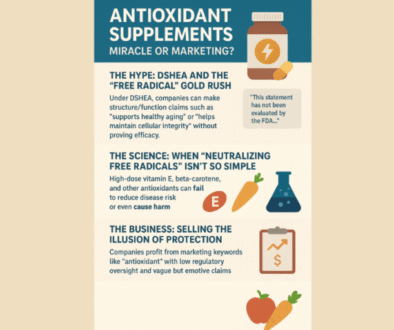
Let’s not forget why you can even buy these bottles without a prescription. In 1994, the Dietary Supplement Health and Education Act (DSHEA) effectively said: “Sure, companies can sell supplements without proving they work, as long as they don’t outright claim to cure disease.”
Translation: companies can market pills with phrases like “supports brain health” or “promotes vitality”—wink, wink—while avoiding the pesky burden of clinical evidence. The FDA only steps in after enough people report problems. Until then, congratulations: you’re your own doctor, pharmacist, and clinical trial participant.
The Comfort of a Diagnosis (Even a Fake One)
Why do we do this? Because having a diagnosis—any diagnosis—feels comforting. It turns random, annoying symptoms into a neat little box with a name and a pill-shaped solution.
Tired all the time? Must be “adrenal fatigue.”
Forgetful? Clearly “brain fog.”
Occasional bloating? Probably “leaky gut.”
Don’t sleep well? “Magnesium deficiency,” obviously.
The beauty of these non-diagnoses is that they’re vague enough to fit almost anyone. Which means they’re perfect for marketing supplements.
The Supplement Aisle: A Candy Store for Self-Diagnosers
Walk into any health store and you’ll see it: rows of brightly labeled bottles practically whispering your symptoms back at you.
“Immune Defense Plus” (because your sniffles obviously mean your immune system is broken)
“Stress Shield” (because your job is hard, and cortisol is the villain of the week)
“Gut Harmony Blend” (because who doesn’t want “harmony” inside their intestines?)
Each label is designed to feel like a diagnosis and a solution rolled into one tidy capsule. And thanks to DSHEA’s structure/function loopholes, these products can legally play doctor without ever having to show real results.
The Illusion of Control
Here’s the real trap: self-diagnosis gives you the illusion of control. You feel proactive, empowered, and health-savvy. And supplement companies know this. That’s why their marketing leans hard into phrases like:
“Clinically studied ingredients” (studied for what? in what dose? who knows?)
“Doctor formulated” (a chiropractor in Idaho counts, apparently)
“Based on science” (doesn’t specify which science… rat studies, maybe?)
It’s like wrapping a placebo in a lab coat. You feel like you’re making evidence-based choices when in reality, you’re buying hope dusted with scientific-sounding jargon.
Why Most “Evidence” Is About as Solid as Jello
Even if you dig into the research behind these products, brace yourself for disappointment. As Dr. John Ioannidis famously showed, most published research findings are false or at least exaggerated—especially when money’s involved. And supplement research is drenched in conflicts of interest.
That “clinically studied” probiotic? Maybe it worked in a petri dish. That “immune support” herbal? The study was on 12 people for 2 weeks. That “doctor recommended” multivitamin? Paid endorsement.
In other words: the “evidence” propping up your self-diagnosis may be just as flimsy as the diagnosis itself.
The Danger of Playing Doctor
Here’s the part people don’t like to hear: supplements aren’t always harmless.
St. John’s Wort can wreck your prescription meds.
Too much vitamin A can wreck your liver.
Too much magnesium can wreck your toilet schedule.
Proprietary blends? Who knows what you’re actually taking—or in what dose.
When you self-diagnose and self-prescribe, you’re skipping the part where an actual clinician rules out serious conditions. That fatigue might not be “adrenal fatigue.” It could be anemia, thyroid disease, sleep apnea—or something else that can’t be fixed with a handful of capsules.
Why Profit Comes First
Let’s not kid ourselves: the supplement industry isn’t in the business of improving your health first—it’s in the business of selling products. Self-diagnosis is their golden goose. The more vague the symptom, the easier it is to sell a bottle labeled “support.” And the more you think you’re in charge of your own care, the less you notice you’re being played.
How to Break the Cycle
So how do you resist the siren song of self-diagnosis?
Start with a professional, not Google. Fatigue, bloating, brain fog—these can have dozens of causes worth ruling out.
Be skeptical of symptom-matching. If a label promises to “support” exactly what you Googled last night, it’s probably marketing bait.
Check the science. Real science, not “clinically studied ingredient” spin. PubMed is free. Use it.
Beware of proprietary blends. They hide dosages for a reason.
Ask yourself who profits. Spoiler: it’s not your mitochondria.
The Bottom Line
Self-diagnosis feels empowering, but it’s often just clever marketing disguised as medical wisdom. DSHEA opened the door for labels to promise “support” without delivering proof, and consumers filled the gap by playing doctor. Add in flimsy research, biased experts, and a profit-driven industry, and you’ve got the perfect storm for wasted money and missed diagnoses.
So next time you feel the urge to Google your way to a diagnosis and a supplement, pause. Ask yourself: Why do I think I need this? Chances are, the real answer is because the label was written to make you think that.